Resources · Solar
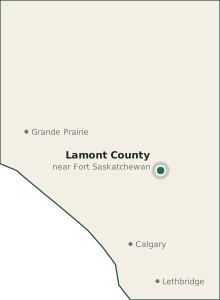
Solar Potential in Lamont County
Lamont County sits in a part of Alberta where summer sun is generous and winter sun is not. Regional NASA POWER-style figures for this belt are about 6.1 kWh/m²/day in high summer and about 0.8 kWh/m²/day in mid-winter. Those figures are horizontal irradiance from the report pipeline's insolation tables for a representative quarter in the county, not a measured year on your roof.
That winter number is the one that sizes batteries, not the July brochure.
Open prairie east of Edmonton with few shading problems and a summer figure close to the regional best. Winter output still falls to roughly a third of summer.
Why county solar is not a system quote
Irradiance is energy hitting a horizontal square metre. A real array has tilt, azimuth, snow, soiling, inverter losses, and shade. Two parcels a kilometre apart in Lamont County can differ more from trees and roof geometry than from climate.
Use the county figures this way:
- Summer ~6.1 kWh/m²/day — enough for pumping, drying, and topping a battery if the array can see the sky.
- Winter ~0.8 kWh/m²/day — the design case for lights, well pumps, and heat-adjacent loads if you are off-grid.
A grid-tied system near Fort Saskatchewan can lean on the summer surplus. An off-grid cabin in Lamont County has to live on the winter number or on a generator.
Shade, snow, and chinook
Walk the site on a low-sun day if you can. Mark:
- Conifers on the south and west lines
- Future shelterbelts you already want
- Roof valleys that hold snow
- A south slope versus a north bench
Lamont County is not the desert, but it is not coastal cloud either. Snow slides off a steep enough rack after a chinook more readily than after a still cold week. Design the rack for both.
A simple sizing sketch (not an electrical design)
For a household that uses 10 kWh/day in January:
- Start from 0.8 kWh/m²/day.
- Apply a 0.7 system factor for cold, snow, and wiring (a conservative sketch, not a code calculation).
- You need on the order of 10 / (0.8 × 0.7) square metres of effective array — then add battery days and a backup plan.
If that area does not fit the south roof, you need ground-mount, load cuts, or a hybrid. The free parcel report will not replace an electrician, but it will show whether the land even faces the problem honestly.
Hardiness and frost-free days (about 120 in this county) also matter: a food-garden pump in May is a different load than a heated shop in January.
See this for your specific parcel
Generate a free land report for a property in Lamont County →
Sampled data for Lamont County
From a Land Intelligence report run on a representative quarter in Township 55, Range 19, W4. These are measured or record-based values for that location, shown to put the county figures above in context. They are not your parcel.
Neighbouring counties: Strathcona County (36 km) · Smoky Lake County (41 km) · Thorhild County (52 km) · Beaver County (57 km) · Compare Lamont County with another county
Sampled from the live report pipeline at a representative quarter in Township 55, Range 19, W4 on 2026-10-08: well depth, hardiness zone, solar irradiance (141 well records within 5 km). Text reviewed 2026-10-08. Methodology.
Common questions
Is winter solar enough in Lamont County?
Winter irradiance here is low. Grid-tied systems still work. Off-grid systems must be sized on the winter number or paired with a generator.
Should I clear trees for solar in Lamont County?
Only after you map December shade and any shelterbelt you still want. Clearing is a design choice, not a default.
Also for this county
- Well drillers serving Lamont County
- Septic installers serving Lamont County
- Solar installers serving Lamont County
- Fencing contractors serving Lamont County
- Excavation contractors serving Lamont County
- Search all providers serving Lamont County
- Read a real report (Crown land, Strathcona County)
- Alberta Resource Economics Atlas: subsurface geology, mines and mineral projects
- Alberta grant program guide and dates calendar